
Panel discussion featuring representatives from Chile, Thailand, Eastern Africa Alliance on Carbon Markets and Climate Finance, GGGI, and UNDP at the report launch during I4C 2026 in Singapore. Photo: Tan Chin Fan/World Bank
Countries are increasingly using climate planning to support broader development objectives, from strengthening competitiveness and mobilizing investment to shaping long-term growth pathways. In this context, Long-Term Strategies (LTSs)- shaped by sector plans - provide the longer-term vision for how sectors and economies can transition toward low-carbon and resilient development, while Nationally Determined Contributions (NDCs) represent countries' near-term climate commitments. Together, they create a coherent planning architecture - one that connects near-term commitments to long-term vision, strengthens investor confidence, and ensures that climate action reinforces broader development goals. As of early 2026, 87 Parties have submitted Long-Term Strategies, while 134 have submitted updated NDCs. The majority of the new NDCs reflect higher ambitions than their predecessors and 14% reported alignment with their LTSs.
Yet implementation remains challenging. Developing economies need an estimated USD 2.4 trillion annually through 2030 to finance the climate transition, far beyond the reach of public finance alone. Carbon pricing instruments and international carbon markets can generate public revenues, mobilize private finance, and strengthen incentives that support economic and climate objectives. When integrated into national climate planning, they can also accelerate NDC delivery, keep long-term decarbonization pathways within reach, and support broader development outcomes by directing revenues toward national priorities and providing clarity to investors. That is precisely what the World Bank’s Guidance for Policymakers on the Role of Domestic Carbon Pricing and International Carbon Credit Markets in Achieving LTSs and NDCs is designed to support.
Launched at Innovate4Climate 2026, this guidance builds upon and is complementary to From Paper to Practice: A Practical Guide to Formulating and Institutionalizing Long-Term Climate Strategies (designed to equip governments and practitioners with implementable insights and a practical how-to framework for formulating and institutionalizing LTSs) and the Country Guidance for Navigating Carbon Markets (focused on whether and how host countries should engage in international carbon credit markets consistent with their NDC ambitions). Together, these resources support governments across the entire climate and development strategy planning and implementation cycle.
A Framework Built Around Where Countries Are
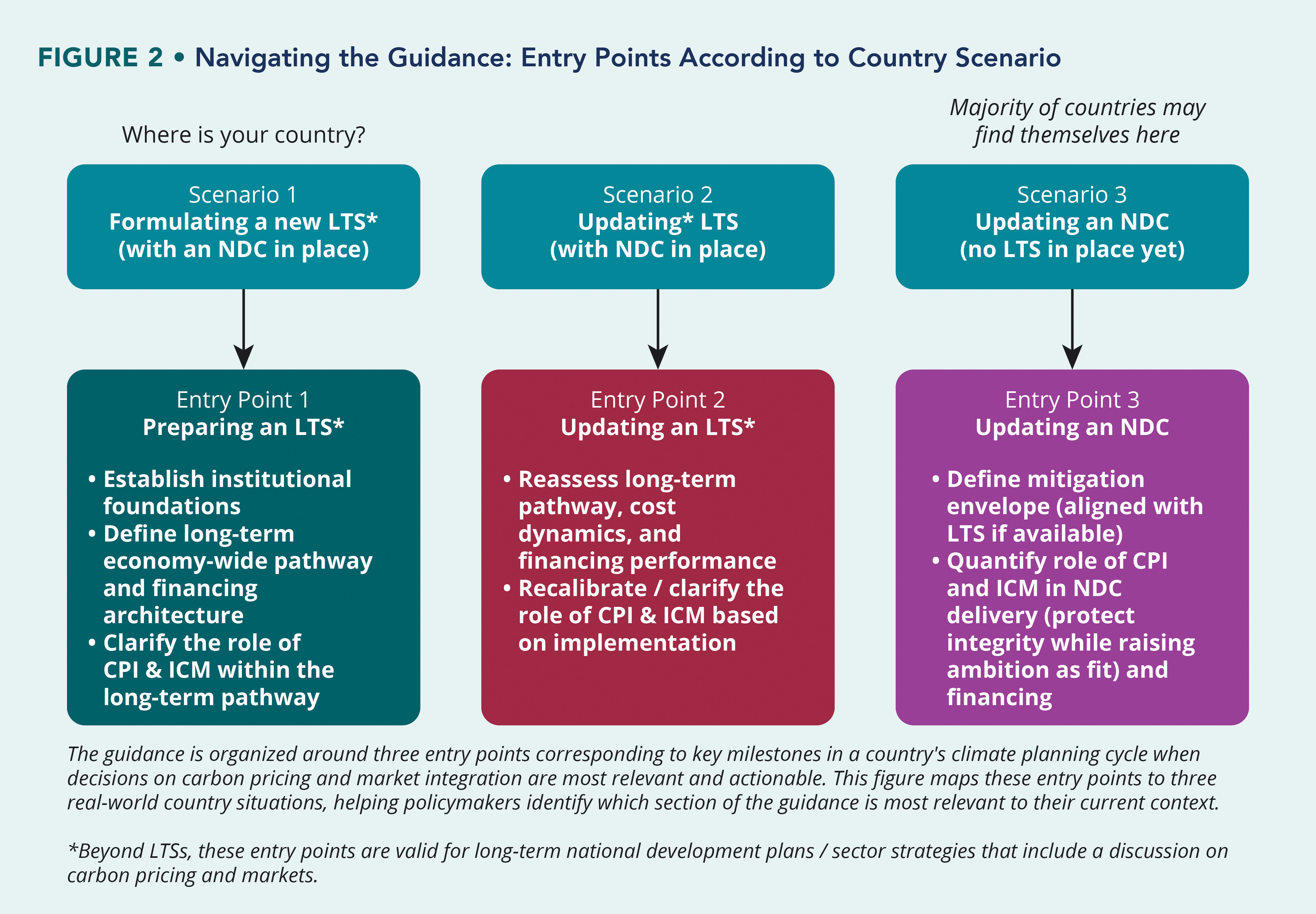
The guidance recognizes that countries are at different points in their planning cycles and offers three entry points - for integrating decisions on CPI and ICM - rather than a single prescribed path. For countries preparing a new LTS, the priority is building institutional foundations and analytical capacity before instrument design begins. For those updating an existing LTS, it is recalibration — sharpening the role of these instruments using implementation experience and new data. For countries updating their NDC, it is precision — quantifying the instruments’ contribution to targets, defining sector eligibility, and protecting domestic ambition.
What Integration Looks Like in Practice
The guidance also draws on a rich set of country experiences to show that integration is practically achievable across very different contexts. Uzbekistan has anchored both its carbon pricing framework and Article 6 engagement within a single ministry, creating a legally enforceable chain from long-term strategy to near-term market decisions. Thailand is building and learning in parallel — developing its ETS pilot while simultaneously advancing its long-term emissions pathway. Chile and Ghana meanwhile show that international carbon credit market engagement and domestic ambition need not compete: Chile used iterative modeling to define what could be transferred internationally and what had to be retained for domestic target achievement, while Ghana decided to apply a Corresponding Adjustment Fee on authorized transfers and direct those revenues back into additional domestic mitigation.
A Practical Tool for the Road Ahead
The experiences of Uzbekistan, Thailand, Chile, and Ghana point to a broader truth: integration is not a destination but an ongoing process, and countries are finding ways to advance it from wherever they stand in their planning cycles. With many countries having already submitted their updated NDCs and others still finalizing them, the conversation is shifting from target-setting to delivery. The guidance - which also includes references to a suite of modeling tools - is designed to support that work, whether a country is anchoring its approach in a formal LTS or a broader long-term development plan. The ambition and momentum are there. This guidance aims to help translate both into action.
Click here to download Guidance for Policymakers on the Role of Domestic Carbon Pricing and International Carbon Credit Markets in Achieving LTSs and NDCs.