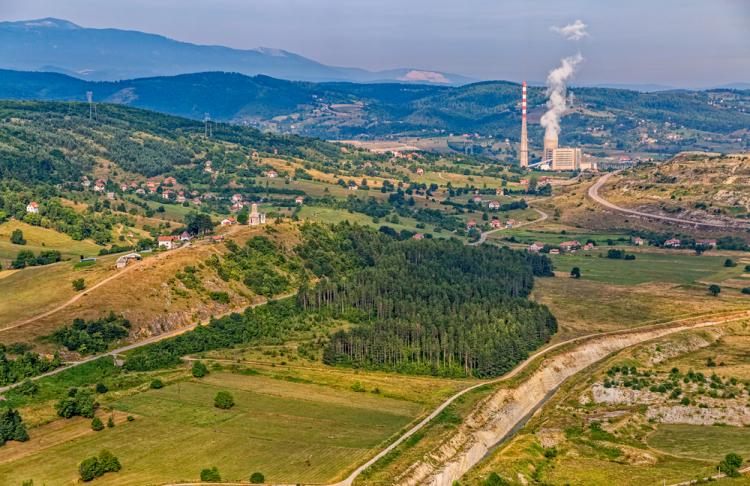
Pljevlja Power Plant, the only coal-fired power station in Montenegro. © Shutterstock
Across Europe and Central Asia, countries are facing a common challenge: how to support communities whose local economies have long depended on traditional industries that are now expected to decline over time. Managing this transition increasingly requires policy tools that both guide economic change and create new fiscal space, including carbon pricing.
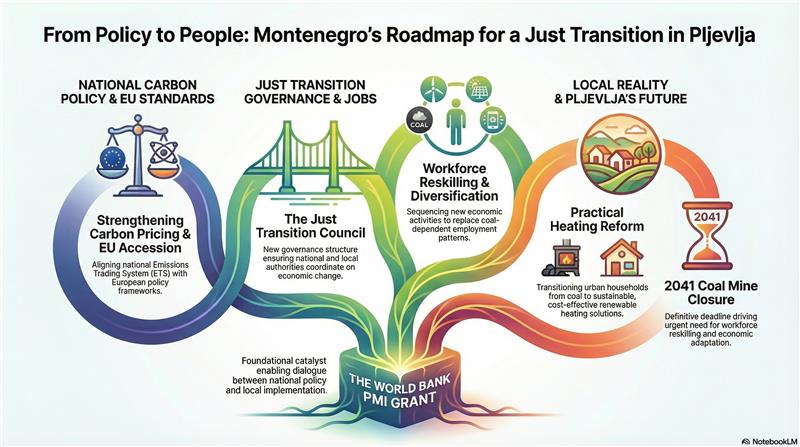
Montenegro is responding with a two-pronged strategy: preparing workers and communities for structural economic change while strengthening its carbon pricing framework with support from the World Bank’s Partnership for Market Implementation (PMI).
Pljevlja: Preparing for Economic Transition
A small town in the country’s north, Pljevlja is home to Montenegro’s only coal-fired thermal power plant (225 MW), which generates roughly half of the country’s electricity, as well as the adjacent coal mine that provides significant local employment. With the coal mine scheduled to close by 2041, the municipality faces long-term economic adjustments that extend well beyond the energy sector.
The key question is not only how energy production evolves, but how the local economy adapts and supports workers and communities throughout that process.
Under the PMI-supported program, Montenegro is developing a Just Transition Plan for Pljevlja, which aims to provide a structured roadmap for economic diversification, workforce adaptation, and long-term regional development. Aligned with European Union guidance and embedded in Montenegro’s broader reform agenda, the plan addresses practical issues that matter to local communities:
- How will employment patterns change over time?
- What new economic activities can complement or replace existing ones?
- What governance structures and partnerships are needed to manage change effectively?
- How can reskilling and economic diversification be sequenced and financed?
The establishment of a Just Transition Council has helped elevate coordination and ensure that national and local authorities work together on these questions.
From Diagnostics to Practical Solutions: Heating Reform
Household heating is a central issue in Pljevlja, both economically and socially. To inform future decisions, a comprehensive heating technology survey was conducted among urban households. The survey provides detailed insights into how households heat today, the socio-economic constraints they face, and the factors that influence decision-making.
Beyond data collection, the study outlines practical measures and support mechanisms that could help households adopt more sustainable and cost-effective heating solutions over time. The findings were presented to local stakeholders in early 2026, strengthening dialogue between municipal and national actors.
Building on this work, a pre-feasibility study on sustainable heating options has been launched. Together, these studies move from understanding current household realities to identifying viable investment pathways that can reduce long-term costs and improve living conditions.
Engaging Communities and Supporting Workforce Adaptation
Economic transition requires trust, participation, and preparation. Stakeholder engagement activities are underway to support Pljevlja in preparing for the gradual phase-out of coal.
The activities aim to clearly communicate the forthcoming changes, encourage community participation in shaping the region’s future, promote uptake of reskilling opportunities, and raise the awareness of national policymakers about local socio-economic challenges.
The effort builds on Montenegro’s National Decarbonization Communication Strategy (2024–2027), previously developed under the PMI grant, helping ensure that economic adjustments are discussed openly and inclusively. Engagement is a continuous, long-term, and multi-faceted process. Creating space for early dialogue helps address concerns in a timely manner and ensures that transition planning remains responsive to community needs.
Linking National Reform and Local Development
Pljevlja’s experience shows that national policy reforms must be accompanied by place-based planning.
Montenegro was the first country in the Western Balkans to introduce a national Emissions Trading System in 2020. Through PMI support, the country is strengthening its carbon pricing framework in anticipation of further alignment with European policy frameworks. But carbon pricing reform alone does not address local economic realities.
Efforts in Pljevlja illustrate a broader principle: structural change can be managed more effectively when economic diversification, reskilling, and community engagement are addressed early and systematically. Pair national reforms with targeted local engagement, economic analysis, and workforce-focused planning to ensure that communities have the tools and information needed to adapt.
Through PMI support, Montenegro is taking concrete steps to prepare its coal region not just for change, but for new economic opportunities.
Find more information about PMI support to Montenegro on the program page.