How can policymakers experience an emissions trading system (ETS) from the perspective of regulated entities and see how different policy choices shape market behavior and compliance? The ETS Lab, an interactive simulation application jointly developed by the Partnership for Market Implementation (PMI) and International Carbon Action Partnership (ICAP), lets policymakers step into the market themselves. By trading allowances, making abatement decisions, and experiencing how choices around the cap, allocation, offsets and other ETS parameters can influence individual’s motivations, ETS Lab participants deepen understanding of both ETS design and implementation.
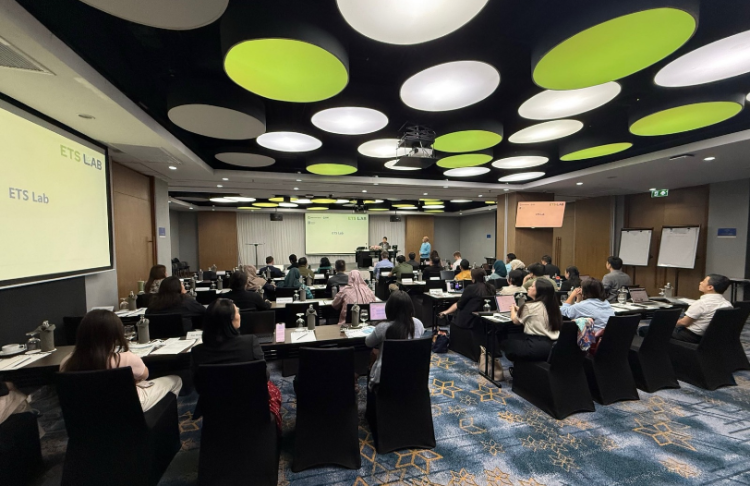
That was the experience of nearly forty government officials from India, Indonesia, Malaysia, the Philippines, Thailand, and Vietnam who participated in the launch of the ETS Lab, which took place during ICAP’s Asia Summer School on ETS Design in Bangkok, Thailand, in September 2026.
Conceived as a modern, user-friendly, and scalable tool to support training, build capacity, and promote learning, the ETS Lab turns concepts into an interactive learning experience. Participants take on the role of regulated entities in a fictitious cap-and-trade system, with one goal: to comply with the lowest cost. They must weigh competing strategies: meet its compliance obligations while managing a budget and deciding whether to invest in emissions abatement, or bid for allowances at auction, or trade allowances with other participants, or purchase and use eligible offsets. They are also tasked to adapt their decisions as prices and market conditions evolve.
From training to scalable solution
The ETS Lab provided a bridge between technical learning and practical application, thus demonstrating that digital tools can complement traditional capacity building workshops. In this way, participants didn’t just hear the theory behind policy design but were able to experience how design choices (such as allocation, cap design and access to offsets) can affect regulated entities’ decisions within a functioning market.
Feedback from participants highlighted the value of learning by doing. Government officials particularly valued the opportunity to experience an ETS from the perspective of regulated entities, make strategic trading and compliance decisions, and see firsthand how market dynamics and policy choices influence outcomes. One participant from Thailand, for example, reflected on how free allowance allocation could weaken incentives for emissions reductions if not carefully designed. The exercise also sparked interest in further applications, with Indonesia expressing demand for a dedicated national training program and India exploring the possibility of an intensity-based ETS simulation.
Designed with scalability and reuse in mind, the ETS Lab has significant expansion potential. The simulation is envisioned by PMI as a cost-effective and adaptable tool that can support governments at different stages of ETS development. As partner countries use the tool more broadly, it can be used to train and educate government officials, regulated entities and other market participants, and to support academic and research applications.
The launch in Bangkok moved the ETS Lab’s journey from prototype to practice. As more countries explore and implement carbon pricing and ETS, demand for practical capacity building will continue to grow. The ETS Lab offers an example of how knowledge developed through one PMI activity can be transformed into a reusable digital solution that is tested with practitioners, improved through user feedback, and scaled across countries.
Jichong Wu is a Climate Change Specialist at the World Bank Group based at its headquarters in Washington, D.C., where he works with the Climate Analytics, Policy and Regulations team to support countries in designing and implementing scalable carbon pricing solutions.