
Satellites can now track forest cover in near real time. Sensors can log the output of mini-grids in villages that have never appeared on a power map. Algorithms can estimate biomass across thousands of hectares in the time it once took a field team to walk one. Digital monitoring, reporting and verification (DMRV) is transforming how carbon market activities are measured and verified with the aim of lowering costs, speeding up issuance and opening access to projects that could never afford traditional monitoring.
But the same features that make DMRV promising can also raise the stakes. If a model is wrong or data is tampered with, the problem does not stay in one project. It can be replicated across hundreds of credits and several countries before anyone catches it, and the credibility of the market suffers with it. So the question is no longer whether carbon markets should use digital MRV, but how to do it without eroding the trust the market depends on.
A new report tackles that question head on. The Integrity Council for the Voluntary Carbon Market (ICVCM) has published the report of its Continuous Improvement Work Program (CIWP) on DMRV, co-facilitated by the World Bank Group (WBG). The report sets out 16 recommendations for designing and implementing digital MRV systems that strengthen integrity across both voluntary and Article 6 carbon markets.
The work program builds on the foundational work of the Carbon Markets Infrastructure (CMI) Working Group, supported by the Partnership for Market Implementation (PMI). Its starting point was a survey drawing on a broad cross-section of the carbon market ecosystem, which highlighted both strong momentum behind digital MRV and the nuance required as it scales.
Three aspects stood out:
- The central role of data quality and uncertainty, with limited convergence on how to define, quantify and disclose it;
- Diverging views on thresholds and the treatment of incomplete or missing data, especially in data-sparse contexts;
- A clear tension between ensuring integrity and inclusion, particularly for smallholder and community-based projects.
These insights confirmed that the conversation has shifted from potential to implementation: how to ensure DMRV systems are robust, credible and interoperable across diverse contexts.
To translate this into concrete guidance, the work program convened a series of structured sessions with more than 20 entities, including standards agencies, validation and verification bodies (VVBs), infrastructure providers, scientists and philanthropies. Sessions covered data quality and uncertainty; algorithms, models and AI/ML; roles, responsibilities and remedies; equity and access; and verification in DMRV.
Ismaila Wiafe, an ICVCM Expert Panel member and Co-Facilitator of the CIWP on DMRV, puts it in a compelling way: "DMRV is not merely about using new technology. It is about strengthening trust in carbon markets." He continues: "When designed with reliable data, transparency, accountability, and inclusion at its core, it can improve efficiency while providing greater confidence that carbon market outcomes are real, credible, and verifiable."
Where technology meets carbon market integrity
A central finding is that ICVCM's existing Core Carbon Principles (CCPs) and CCP Assessment Framework already provide a strong foundation for assessing integrity in a digital context. The challenge is ensuring that they are applied consistently as technologies evolve. The 16 recommendations address governance, cybersecurity, transparency, verification, community impacts, and capacity building.
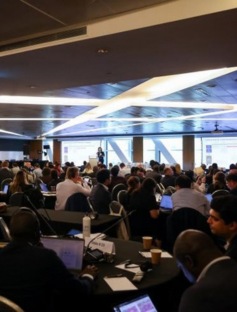
Several themes run through the report, many of which were first surfaced at a discussion co-hosted by ICVCM and the WBG at Innovate4Climate 2026 in Singapore:
- DMRV requires a system-wide approach to integrity and risk. Integrity challenges extend beyond individual data points to the full digital system (data flows, models and infrastructure), with risks of error or manipulation potentially cascading across projects and geographies if not properly governed.
- Data governance and transparency involve complex trade-offs. Tensions persist around data access, privacy and disclosure, particularly given national data regulations, requiring balanced approaches and potentially alternative assurance mechanisms beyond full transparency.
- Practical feasibility and technological limits must guide adoption. DMRV design must reflect what technologies can and cannot currently do, alongside costs, infrastructure constraints and inclusivity challenges, especially in developing countries.
- The VVB function is undergoing a fundamental shift. Verification bodies will need to move from document review to assessing entire digital systems, including data pipelines and potentially underlying code, requiring new skills in data, AI and system architecture. This complements ICVCM's recently published report on Oversight of VVBs.
ICVCM's role as integrity "bar setter". ICVCM should operate at the meta-level, setting integrity expectations and frameworks that are translated by programs into methodologies and implemented at project level. Emerging developments such as near-real-time issuance, digitized methodologies and links to digital carbon assets and tokenization signal areas where further guidance may be required.
Why this matters to countries around the world
The work on DMRV illustrates how high-quality technical assistance can bring together different parts of the carbon market ecosystem, create space for new partnerships, and help promising ideas move toward practical solutions. This is the space in which PMI, the WBG’s flagship program on carbon pricing, operates and makes a difference, and it is the space in which this report sits. For countries building MRV systems under Article 6, the report offers practical guidance for adopting digital approaches without compromising integrity.
Read the full report here.
For more on the CMI Working Group's foundational work on DMRV, download the Technical Guidance Note on Standardizing Digital MRV in Carbon Markets: System Evaluation Criteria and Hotspots Assessment.
Gemma Torras Vives is a Climate Change Specialist at the World Bank Group based in Singapore, where she works with the Carbon Finance Solutions team to help countries design and deploy carbon finance infrastructure.
Anton Tsvetov is the Director for Continuous Improvement Work Programs at the Integrity Council for the Voluntary Carbon Market (ICVCM), where he brings together market experts and stakeholders to evolve, harmonise, standardise, and modernise the Integrity Council’s threshold for high-integrity carbon credits.