
Kounounkan, Guinéa. Photo credit: Xavier Bourgois
Guinea is working to become the first country in Africa to launch a sector-based carbon pricing instrument, initially covering two key industries: bauxite and iron ore mining. The targeting of a sector central to Guinea’s economy is significant. Guinea is the world’s second-largest exporter of bauxite and developing what may become the world’s largest iron ore mining operation in the country’s southeast region.
The instrument is designed to provide a framework for setting emissions-intensity targets for mining operations, and incorporates several features to ensure effectiveness, fairness, and alignment with national priorities. Its design is led by the Ministry of Environment and Sustainable Development and has been informed by PMI technical support. It is a hybrid, intensity-based mechanism, which applies a carbon price only on emissions that exceed a specific, output-based intensity target (e.g., tonnes of CO2e per tonne of ore). The intensity-based approach is deliberate, allowing operators to improve operational efficiency and reduce emissions while maintaining flexibility in production levels.
Other key design elements include:
Targeted Coverage: Initially, the carbon pricing instrument focuses on the bauxite and iron ore sectors. To ensure fairness and broad participation, it will cover all companies, with a "de minimis" exemption for the first 50,000 tonnes of annual CO2e emissions, below which companies do not pay but are still subject to mandatory reporting.
Aligned Target-Setting: Long-term goals are derived directly from Guinea’s Nationally Determined Contribution (NDC 3.0). While a common long-term intensity target applies to each sub-sector, short-term targets will be defined at the level of individual mining installations, allowing for differentiated pathways across operators.
Flexible Compliance: Operators have multiple ways to meet their obligations. The primary method is making payments into a dedicated Mitigation Fund. Companies may also use domestically generated carbon credits, expected from Guinea’s forestry and energy sectors, to cover a portion of their liability, contributing to the development of domestic carbon market and consistency with Article 6 of the Paris Agreement.
Strategic Revenue Use: All revenues will be channelled into a Mitigation Fund, which will finance decarbonization investments in the mining sector (e.g., grants or low-carbon technology) as well as other national climate-related activities.
Progress on Design and Institutional Setup
Progress to date has been focused primarily on the development of the policy frameworks and supporting institutional arrangements. Technical systems for monitoring greenhouse gas (GHG) emissions have been developed, and a mining-sector GHG accounting tool has been piloted with several major operators. As of April 2026, a decree mandating mining operators to report on GHG emissions is under review.
Institutional roles and responsibilities have been defined across relevant government entities, including the establishment of a Carbon Unit within the Ministry of Environment and Sustainable Development to oversee implementation and monitoring. Draft sector-specific regulatory frameworks have been prepared for both the bauxite and iron ore industries, including proposed methodologies for setting installation-level emissions-intensity targets and outlining compliance options.
The instrument is expected to be implemented in phases, beginning with a transition period focused on data collection, testing of systems, and capacity building. Several key design elements remain under development, including the determination of the carbon price level, finalization of the legal and regulatory framework for enforcement, and the establishment of systems for verification and fund management. These aspects will be critical to the operationalization of the instrument and will be the focus of the next phase of work.
High-level political engagement has supported the development of the instrument. Prime Minister Amadou Oury Bah noted at an event in Conakry, Guinea, in October 2025 that, “Guinea’s role on the international carbon pricing stage and its commitment to implementing a carbon pricing instrument in the mining sector as a means of contribution to climate change mitigation.”
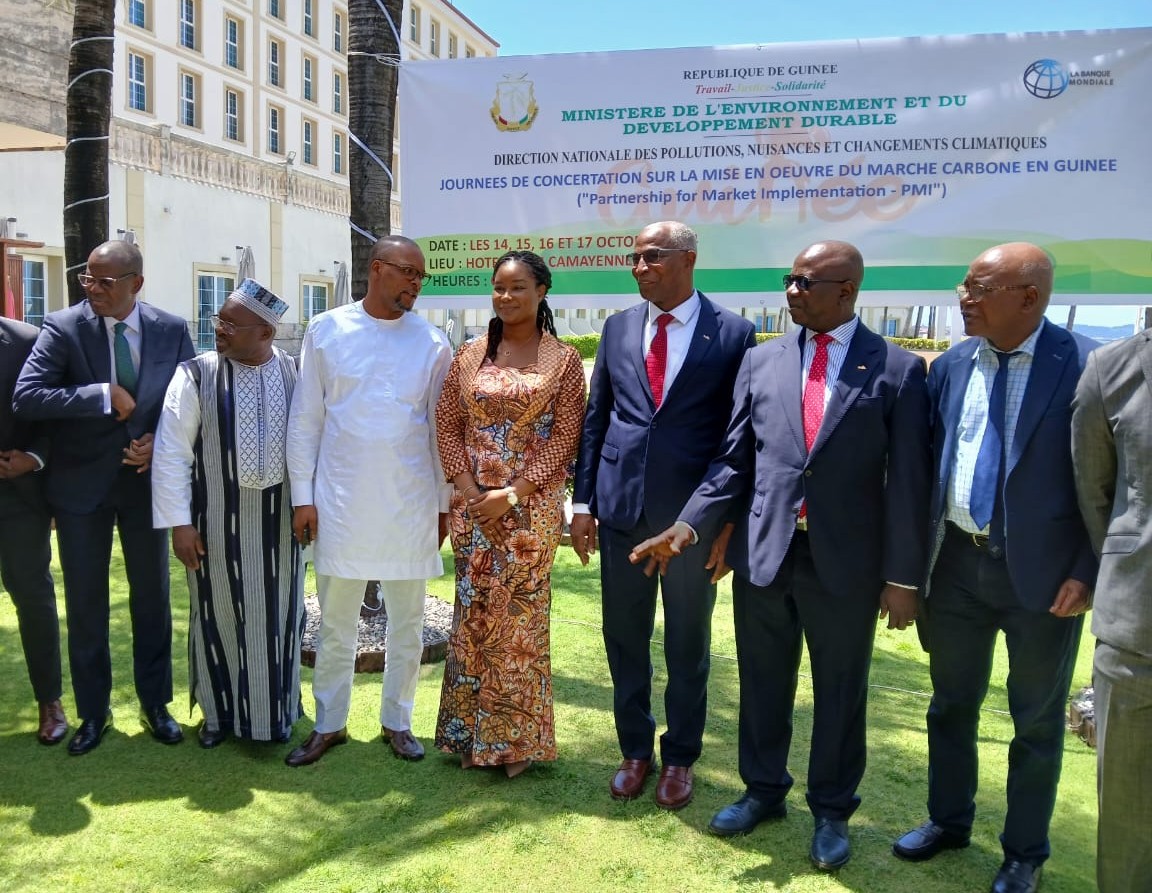
Guinea’s Prime Minister Amadou Oury Bah with Minister of Environment and Sustainable Development (MEDD) Djami Diallo and other senior government officials. Photo credit: PMI.
The government has also engaged stakeholders through workshops involving industry, civil society, and local community representatives to inform the design process and support broader understanding of the proposed instrument.
To learn more about PMI’s engagement in Guinea, please visit the Guinea program page.